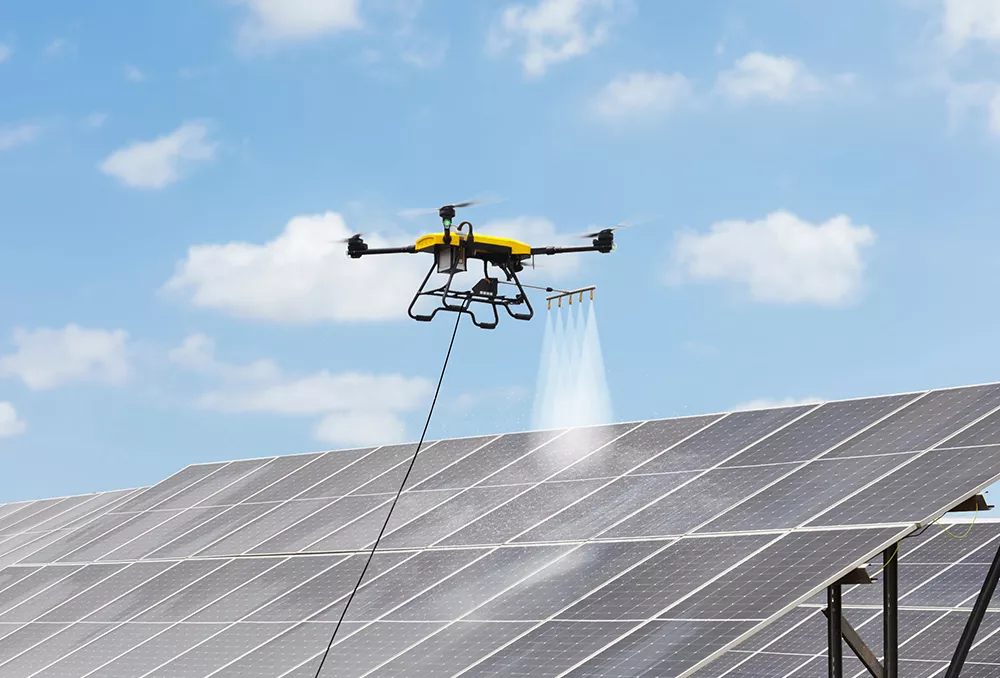




Drone house cleaning removes the need for climbing ladders or working at risky heights. With operators controlling drones from the ground, exterior areas.
Drones require minimal setup and can clean large sections of a house in a short time. This makes the process fast and convenient, with little disruption to your daily routine.
By reducing the need for heavy equipment and extensive labor, drone cleaning helps lower overall costs. Homeowners can enjoy high-quality results without spending excessively on maintenance.
Drone cleaning uses less water and supports environmentally friendly solutions. Its precise application reduces waste, making it a sustainable option for modern home care.
The process starts with a detailed inspection of the house exterior. Professionals evaluate areas like the roof, walls, windows, and gutters to identify dirt buildup, stains, or sensitive surfaces, ensuring the right cleaning approach is selected.
Specialized drones are then deployed to carry out the cleaning. Operated from the ground, they use controlled spraying systems to apply water or eco-friendly cleaning solutions, reaching high or hard-to-access areas with precision and consistency.
After the cleaning is completed, a final check is performed to ensure all surfaces are thoroughly cleaned. Any missed spots are addressed, leaving the house exterior fresh, clean, and well-maintained.
Trustindex verifies that the original source of the review is Google. Great job cleaning my solar panels.Trustindex verifies that the original source of the review is Google. I needed to find a reputable company to install critter guard around 57 solar panels I have on my roof. After some research, I decided on Solar Technologies LLC. Owner and operator Jeff Fergusson took my information (panels, direction etc.), gave me a very good reasonable quote, and always addressed me with respect. I asked Jeff to remove the existing broken guard and asked him to match the material of a bid we could not afford. Which he did. He also heard agreed on every installation request I asked for, with gratitude and respect. He was patient waiting for my decision and when he was awarded the bid, we agreed on a time. Jeff showed up with 2 other men all of them respectable, polite, and hard working. They showed u on time and worked all day, literally, until the job was finished. He sent me photos of the work, then walked me over what they did and showed it to me in person. If you need critter guard installed around your solar panels or need them cleaned he is the man and his company is by far one of the best I have worked with. Thank you Jeff and team for everything.Trustindex verifies that the original source of the review is Google. We hired Jeff to install critter guard around 50+ solar panels. Jeff went above and beyond to provide legendary service. He did an amazing job! Can’t recommend him enough! I’m a roofing contractor so I work with a lot of contractors. Jeff has to be one of my favoritesTrustindex verifies that the original source of the review is Google. Jeff was incredibly nice and easy to work with. The quality of his work was outstanding and reasonably priced.Trustindex verifies that the original source of the review is Google. It was an absolute pleasure working with Jeff. He exceeded my expectations for the cleaning of the outside house windows. Jeff was very professional, knowledgeable, courteous, and easy to talk to. I would definitely recommend his company for window cleaning. I will be a repeat customer!Trustindex verifies that the original source of the review is Google. I have 41 solar panels and for the price of cleaning them, Solar Restoration quote was very reasonable. The panels look brand new after the cleaning and my kwh has increased going to the grid. I will definitely use them again when the panels start to get dirty.Trustindex verifies that the original source of the review is Google. Solar Restoration: Very professional, knowledgeable, and kind (e.g., referring to everyone involved). Also, the level of attention to detail while on the job was commendable! Overall, Jeff’s work was a cut above. Thx!Trustindex verifies that the original source of the review is Google. OMG. Mr. Jeff did an amazing job. My windows look brand new. Highly recommend him. & what I love too it didn’t take him long at all. Thanks. See you soon.Trustindex verifies that the original source of the review is Google. Excellent work!!! I didn’t realize how dirty my windows were until they were cleaned. Spotless and CRYSTAL clear as if they were brand new!!! I highly recommend and I will be using the services bi-annually moving forward.Trustindex verifies that the original source of the review is Google. Very professional and courteous business. From initial contact, I was impressed with the tone and expertise. Very good communication, demonstrated with a patient approach to answering questions in detail. The service was immaculate, my exterior looks brand new. He even took time to show me how to operate certain equipment to ease maintenance going forward. I am grateful, can’t wait for my family to come home and see this work! We will be on a recurring service. Thank you sir.